Archive Notice: The Canary Wharf Choir concluded its activities in 2019.
This website is preserved to celebrate the choir legacy and community music-making.
Who can be in the choir?
Anyone could join. We expected singers either to live in the Canary Wharf area or work in the area, although exceptions could be made. We had no child members, but young choristers occasionally participated in events such as carol singing in Canada Square Shopping Mall or occasional concerts, if accompanied by a parent or guardian.
Do you hold auditions?
Never! But we did hope that members could sing in tune — not that every member managed that every time.
Do I need any experience of singing?
No experience was necessary — just enthusiasm.
Do you have to read music?
Not necessarily. We used sheet music, and rehearsals were a good opportunity to improve music-reading skills. Rehearsals also enabled members to learn by ear: all they had to do was listen.
Who paid for the sheet music?
Songs were usually available online, and sometimes the choir provided out-of-print music. Our Christmas Carols & Candles Service could usually be covered by 100 Carols for Choirs by John Rutter and David Willcocks.
I'm not sure I can hold a part in harmony.
Songs were sung in parts, sometimes as rounds. Each part was taught separately, and singers chose a part and sat with others singing the same part.
If a song is in another language, how will I manage?
Many songs were in languages that are largely phonetic, where the words sound as expected from the written form. For other songs, we used a phonetic version to help us sing the words correctly. It was surprising how quickly everyone picked it up.
Did the choir perform to the public?
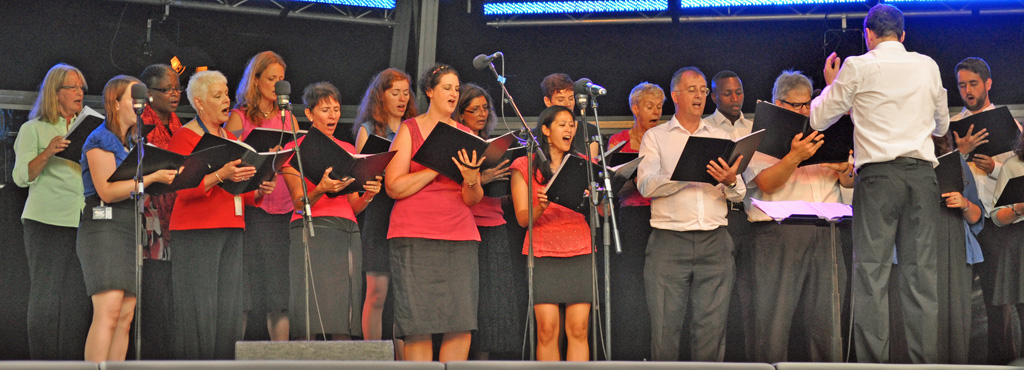
The choir occasionally performed at public events, aiming for one performance each season where possible. Participation was voluntary. The main purpose of the choir was to sing for pleasure, entertain friends and families, and raise money for good causes.
Did the choir sing unaccompanied?
We often had piano accompaniment, and sometimes organ accompaniment, especially at Carols & Candles services. On occasion, we also had soloists from inside and outside the choir.
When and where did the choir meet?
The choir met on Monday evenings from 6:30pm to around 8:00pm in the State Street Bank Building, Canary Wharf, at 20 Churchill Place, E14 5HJ. The building was fully accessible.
How much did it cost?
The cost was £25 per year, or £12.50 after 30 June, payable at the first practice unless attending a free taster session. Sheet music was extra, and singers were responsible for obtaining legal copies of music practised and performed.
Who could get a concession on the cost?
People on low income, self-defined; under-18s; and those in full-time education.
Was there parking near the venue?
Waitrose had a parking garage, but members generally came on foot from Canary Wharf office blocks or by public transport. There was disabled access at the front of 20 Churchill Place, and a London bus stop directly in front of the building.
Who ran the choir?
The choir was run by, and assisted by, a small committee of members responsible for general organisational issues.
Plus our esteemed, lovely and very talented guest directors: Miriam Coe and Miguel Esteban.
How big was the choir?
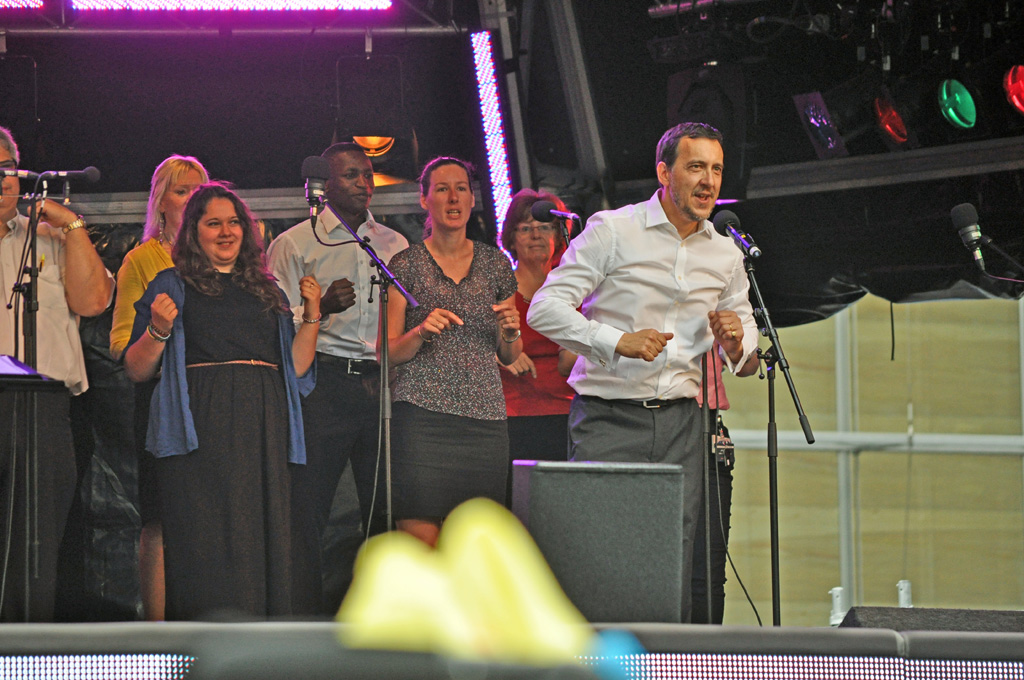
There were usually between 30 and 50 active singers, with numbers fluctuating, and the mailing list had around 150 members. The number could be capped and a waiting list used, although this was not usually needed. We were always looking for new singers, whether experienced, enthusiastic, or both.
Could family members hear us sing?
Most performances were public events. The Carols & Candles annual Christmas concert was free, although tickets needed to be ordered through the Canary Wharf events website. The choir aimed to have one performance each term and/or a sharing of what had been learned for families and friends. Members could take part if they wished.